
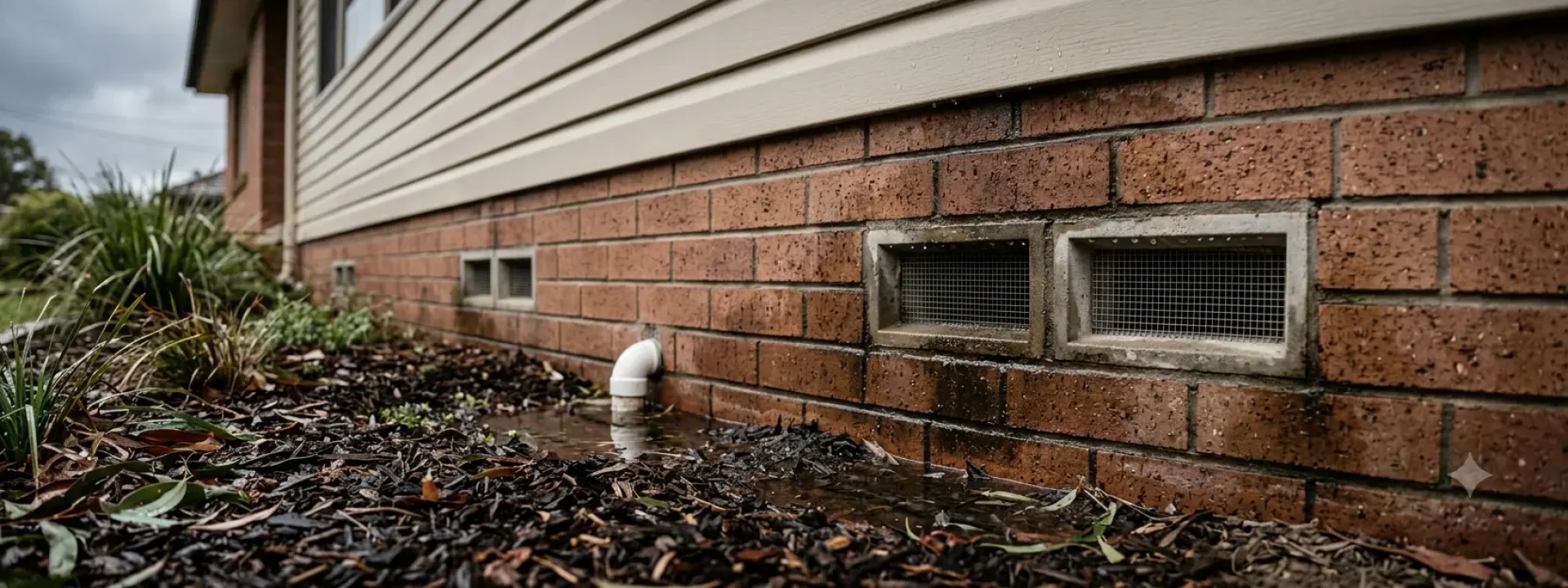
Climate change subfloor moisture Sydney homes are experiencing isn’t a future concern – it’s showing up in verified climate data collected over the past two decades. Climate change subfloor moisture Sydney properties face is driven by a specific, measurable shift: rainfall isn’t just becoming more frequent or less frequent overall, it’s arriving in shorter, more intense bursts that existing subfloor drainage and ventilation design wasn’t built to handle. This guide looks specifically at what the data shows and what it means at the level of subfloor engineering, rather than repeating general climate change discussion already covered in our broader guide to climate change and Sydney homes.
That earlier guide covered the wider picture – insurance, heritage properties, and long-term planning. This post goes narrower and more technical: what’s actually changed in Sydney’s rainfall and temperature data, and what that specifically means for how a subfloor should be designed and maintained going forward.
What the Data Actually Shows About Climate Change Subfloor Moisture Sydney Faces
Rather than general climate projections, this section focuses on findings specific to the Sydney region with a clear, checkable source.
A 40% Increase in High-Intensity Short-Duration Rainfall
Research led by the ARC Centre of Excellence for Climate Extremes, in collaboration with UNSW and the Bureau of Meteorology, analysed weather radar data from stations at Newcastle, Terrey Hills, and Wollongong and found that short-duration, high-intensity rainfall events – specifically those under an hour – increased by 40% over the Sydney region across the two decades studied. This is a significant finding for climate change subfloor moisture Sydney properties are dealing with, because it points to a very specific kind of change: not necessarily more total rainfall over a year, but more of that rainfall arriving in sudden, intense bursts.
Why Short-Duration Intensity Matters More Than Annual Totals for Subfloors
Subfloor drainage systems, stormwater infrastructure, and ground-level drainage around a home’s foundation are generally designed around historical extreme rainfall data – meaning the intensity of rainfall a system was built to handle reflects rainfall patterns from decades ago, not current conditions. Researchers involved in the Sydney rainfall study specifically noted that existing water infrastructure standards were developed using historical data, and that this creates a genuine mismatch as short-duration rainfall intensity keeps climbing. For climate change subfloor moisture Sydney homes are exposed to, this mismatch means drainage designed to handle yesterday’s normal downpour can be genuinely overwhelmed by today’s, even without any change in total annual rainfall.
NSW Temperature and Sea Level Trends
According to the NSW Government’s State of the Environment reporting, average surface temperatures over land in NSW have risen 1.4°C since national temperature records began in 1910, and sea levels along the NSW coast rose 12 centimetres between 1991 and 2023, with further rise of up to one metre projected by the end of the century under current trajectories. Sea surface temperatures in the Sydney area have also increased by roughly 0.14 to 0.2°C per decade since the 1950s. These trends matter for climate change subfloor moisture Sydney coastal and low-lying properties experience specifically because warmer air holds more atmospheric moisture – a well-established physical relationship where each degree of warming increases the atmosphere’s moisture-holding capacity – and because rising sea levels directly affect groundwater tables in low-lying coastal areas.
Engineering Implications: Why Existing Subfloor Design May Fall Short
Understanding the specific nature of the data – intensity increases rather than simply more total rain – points to specific, practical implications for subfloor systems.
Drainage Systems Designed for Historical Rainfall Patterns
Because stormwater and site drainage standards were developed using historical extreme rainfall records, a drainage system that met the relevant standard when a home was built decades ago may no longer be adequately sized for the short-duration rainfall intensities Sydney is now experiencing. This is a genuine engineering mismatch, not a maintenance failure – the system may be functioning exactly as designed, but the design assumptions it was built on have shifted. Climate change subfloor moisture Sydney properties are experiencing as a result of this mismatch often shows up as sudden, short-lived subfloor flooding or saturation during intense downpours, even on properties with no history of drainage problems during more moderate, longer-duration rain events.
Ventilation Systems Sized for a Different Moisture Load
Subfloor ventilation systems installed years or decades ago were sized based on the moisture load and rainfall patterns understood at the time of installation. As short-duration rainfall intensity increases, subfloors may need to handle brief but severe moisture influxes more frequently than the original system’s design anticipated, even where average annual conditions haven’t shifted dramatically. This is a genuine reason to reassess an older ventilation system’s adequacy against current climate change subfloor moisture Sydney conditions, rather than assuming a system that performed acceptably in the past will continue to do so as rainfall patterns continue to shift.
Reactive Clay Soils Under More Volatile Moisture Cycling
As covered in our guide to Sydney’s soil and moisture science, reactive clay soils across the Cumberland Plain expand and contract based on moisture content. More intense, concentrated rainfall events followed by continued warming and evaporation between events plausibly increase the volatility of this shrink-swell cycle, though the specific engineering consequences depend heavily on the individual site’s soil classification and drainage design. Properties on Class H1 or H2 reactive clay sites, already managing significant ground movement under AS 2870, are a reasonable priority for reviewing whether current drainage and ventilation design accounts for more intense, concentrated rainfall inputs.
Coastal and Low-Lying Groundwater Implications
For properties in low-lying, high-water-table locations – including parts of the Eastern Suburbs sitting above the Botany Sands Aquifer, and areas near the Cooks River, Georges River, and Parramatta River – measured sea level rise directly affects the height of the local groundwater table over time, since coastal and estuarine groundwater levels are influenced by sea level. Climate change subfloor moisture Sydney homes in these specific locations face isn’t primarily about rainfall intensity but about a gradually rising baseline groundwater level, a genuinely different mechanism requiring different long-term planning than the drainage-overwhelm pattern relevant to inland reactive clay sites. Where a persistently high water table has already produced visible mould in affected subfloor timber, that requires dedicated mould solutions rather than a drainage adjustment alone.
What This Means for Subfloor Assessment and Design Going Forward
Given these specific, data-backed shifts, several practical adjustments are worth considering for both existing properties and any new ventilation work.
Reassessing Older Systems Against Current Conditions
A subfloor ventilation or drainage system installed more than a decade or two ago was designed against a different rainfall intensity baseline than currently applies. This doesn’t mean every older system is now inadequate, but it’s a reasonable basis for scheduling a fresh assessment, particularly for properties that have experienced any unusual, sudden subfloor moisture events in recent years that didn’t previously occur under similar rainfall totals, or where capillary rising damp treatment has become a recurring rather than one-off issue.
Designing New Systems With a Safety Margin
For new installations or major upgrades, designing to the bare historical minimum specified by older reference data may leave less margin than is prudent given the documented trend toward more intense short-duration rainfall. A subfloor ventilation specialist working on a new system can factor in a reasonable margin above historical minimums, particularly on sites already identified as higher-risk due to soil type, low-lying position, or limited natural drainage.
Prioritising Drainage Alongside Ventilation
Because the data specifically points to rainfall intensity – a drainage and stormwater management issue as much as a ventilation one – addressing site drainage (downpipe capacity, ground slope, stormwater connection adequacy) alongside any ventilation upgrade is increasingly important, rather than treating ventilation capacity as the only variable worth reviewing. Where increased drainage load has already led to visible capillary moisture patterns in masonry, that’s a signal to also assess rising damp treatment needs rather than assuming a drainage fix alone will resolve every symptom.
Monitoring as a Practical Response to Uncertainty
Given that climate trends continue to evolve and the exact pace of further change carries genuine uncertainty, ongoing subfloor humidity monitoring provides more useful, current information than a one-off assessment based on historical averages alone. This is a pattern discussed in more general terms in our climate change and Sydney homes guide, and it applies with particular relevance to the specific rainfall-intensity trend covered here, since monitoring can flag a growing mismatch between existing system capacity and actual conditions well before it results in visible damage.
Recent Sydney Rainfall Extremes in Context
The intensity trend documented in the UNSW-led research isn’t a purely theoretical or abstract dataset – it lines up with lived experience for many Sydney homeowners. The extended wet period across 2021 and 2022 brought repeated, significant flooding and prolonged ground saturation to large parts of the Sydney basin and surrounding NSW regions, an experience many properties hadn’t seen at that frequency in previous decades. Climate change subfloor moisture Sydney homes experienced through that period wasn’t an isolated anomaly in hindsight – it’s consistent with a documented trend toward more frequent intense rainfall, rather than a single unusual season unlikely to recur.
Heatwaves, Evaporation, and Clay Soil Volatility
Alongside more intense rainfall, NSW is also experiencing more frequent hot days and heatwave conditions, based on the same NSW Government environmental reporting referenced above. Hotter, drier periods between rainfall events increase surface evaporation and can intensify the drying and shrinkage phase of the reactive clay cycle discussed in our soil and moisture science guide, meaning the swing between saturated and dry conditions may be becoming more pronounced at both ends, not just wetter during rain events. This combination – more intense wet periods and more intense dry periods – is a specific reason reactive clay sites deserve particular attention when reviewing climate change subfloor moisture Sydney impacts, since the soil itself is subject to a wider range of moisture extremes than it may have experienced when a property’s original footing and drainage design were calculated.
Practical Steps for Property Owners Now
Given the specific, documented nature of these trends, several concrete steps are more useful than waiting for further data before acting.
Request a Capacity Check, Not Just a Condition Check
When booking a subfloor assessment, specifically ask whether the existing ventilation and drainage capacity is being checked against current rainfall intensity data, rather than only confirming the system is functioning as originally installed. A system can be in good working condition and still be undersized for today’s climate change subfloor moisture Sydney conditions if it was never reassessed against updated intensity data.
Prioritise Drainage Upgrades on Older Properties
Given that the clearest documented shift is in short-duration rainfall intensity, reviewing and upgrading site drainage – gutter and downpipe capacity, ground grading, and stormwater connection sizing – is a particularly high-value step for older Sydney properties whose drainage was designed under earlier standards, independent of any separate subfloor ventilation review.
Factor Climate Trends into Renovation Planning
Anyone planning a renovation or extension has a natural opportunity to upgrade drainage and ventilation capacity to reflect current conditions rather than simply replicating existing design. Building in a reasonable margin above historical minimums at this stage is considerably cheaper than retrofitting additional capacity later once a mismatch between design and actual conditions becomes apparent through recurring moisture problems.
Suburb and Site-Type Considerations
The specific climate change subfloor moisture Sydney mechanism most relevant to a property depends heavily on its location and underlying soil and drainage conditions.
Western Sydney Reactive Clay Sites
Suburbs across the Cumberland Plain – Parramatta, Blacktown, Liverpool, Penrith, and the Hills District – combine already-significant reactive clay moisture cycling with the documented trend toward more intense, concentrated rainfall. These sites are a priority for reviewing climate change subfloor moisture Sydney impacts specifically, since current drainage capacity, not just ventilation, needs to match today’s rainfall intensity rather than the standards in place when the property was built.
Low-Lying Eastern Suburbs and River-Adjacent Areas
Properties near Botany, Centennial Park, and the catchments of the Cooks River and Georges River sit closer to groundwater systems directly influenced by measured sea level rise, making gradual, longer-term groundwater trends the more relevant climate change subfloor moisture Sydney mechanism for these specific locations, rather than short-duration rainfall intensity alone.
Established Suburbs With Older Infrastructure
Established suburbs across the Inner West, including Balmain, Leichhardt, and Marrickville, often combine older stormwater infrastructure – designed to historical standards – with the geological transition-zone soil variability discussed in our soil and moisture science guide. This combination makes a current, site-specific drainage and ventilation review particularly worthwhile rather than assuming decades-old original design remains adequate.
New Development Areas
Newer growth corridor suburbs, including parts of the North West Growth Corridor around Kellyville, have the advantage of being built under more recent design standards, but should still confirm that drainage and ventilation systems accounted for current rainfall intensity data rather than only the minimum standard in place at time of construction approval.
North Shore and Northern Beaches Sandstone Sites
Sandstone-based suburbs across the North Shore and Northern Beaches generally drain more freely than clay-based sites, but the same documented increase in rainfall intensity still matters here in a different way: sandstone country’s characteristic steep valleys and rock shelves can direct sudden, concentrated stormwater flow toward specific low points on a property faster than more gently graded clay landscapes, meaning surface drainage design – not subfloor moisture retention – is often the more relevant climate change subfloor moisture Sydney consideration for these particular sites.
Why This Analysis Differs From General Climate Preparedness Advice
It’s worth being direct about why this guide takes a narrower, more technical approach than a broader discussion of preparing a home for climate change generally. Climate change subfloor moisture Sydney homes face has a specific, checkable evidentiary basis – documented rainfall intensity data, published temperature and sea level figures, and an established physical relationship between temperature and atmospheric moisture capacity – and the practical response follows directly from that evidence: reassess drainage and ventilation capacity against current, not historical, conditions. This is deliberately distinct from broader home preparation topics like insurance implications, heritage property considerations, or long-term property value planning, which our earlier climate change and Sydney homes guide addresses in more general terms. Where that guide asks “how should I prepare my home overall,” this one asks a narrower question: “does my subfloor’s drainage and ventilation capacity match what Sydney’s rainfall actually looks like now.”
Where Ventilation Fits Alongside Broader Climate Adaptation
Subfloor ventilation is one part of a broader climate adaptation picture for Sydney properties, alongside drainage capacity, site grading, and, where relevant, structural measures for coastal and flood-prone sites. Where increased moisture exposure has already led to mould establishing in a subfloor space, professional mould solutions address that consequence directly, while capillary moisture patterns showing up alongside increased ground saturation may point to a need for rising damp treatment rather than a ventilation-only response. A comprehensive review that considers ventilation, drainage, and, where applicable, rising damp together gives a more complete picture than assessing subfloor ventilation capacity in isolation from the broader moisture system a property depends on. This kind of integrated review is particularly worthwhile given that the underlying rainfall data shows a genuine, ongoing shift rather than a one-off unusual period, meaning a subfloor assessed and adjusted today should be judged against where Sydney’s climate is heading, not just where it has already been.
Purposeful Information
Q: Has Sydney actually gotten wetter overall, or is it more about rainfall intensity?
A: The clearest, most specific documented trend is intensity rather than simple totals – research from UNSW, the ARC Centre of Excellence for Climate Extremes, and the Bureau of Meteorology found a 40% increase in short-duration, high-intensity rainfall events across the Sydney region over the two decades studied, distinct from a straightforward change in annual rainfall totals.
Q: Does this mean my existing subfloor ventilation system is now inadequate?
A: Not necessarily, but it’s a reasonable basis for a fresh assessment, particularly for older systems and for properties on reactive clay or in low-lying locations. A professional assessment against current conditions is more reliable than assuming a system that worked in the past will remain adequate indefinitely.
Q: How does sea level rise affect a subfloor that isn’t right on the coast?
A: In low-lying areas connected to coastal or estuarine groundwater systems – including parts of the Eastern Suburbs and areas near tidal-influenced rivers – rising sea levels can gradually raise the local groundwater table over time, which is a different mechanism to rainfall intensity but relevant to the same broader climate change subfloor moisture Sydney picture.
Q: Should I upgrade my subfloor ventilation now or wait for more data?
A: The documented rainfall intensity trend behind climate change subfloor moisture Sydney properties are facing is already established using two decades of radar data, not a future projection alone, so waiting for further confirmation delays addressing a pattern that’s already measurable. A property-specific assessment can determine whether your current system has adequate margin.
Q: Is drainage or ventilation the bigger priority given these findings?
A: Both matter, but the specific rainfall-intensity finding points particularly toward drainage capacity – since it’s about water arriving faster than existing stormwater and site drainage systems were designed to handle – alongside, not instead of, adequate subfloor ventilation capacity.
This guide references publicly available climate research and NSW Government environmental reporting current as of publication and is intended for general educational purposes. Climate data and projections are periodically updated; for the most current figures, consult the Bureau of Meteorology and NSW Government climate reporting directly. For a property-specific assessment, consult a qualified subfloor ventilation specialist with experience in Sydney conditions.