
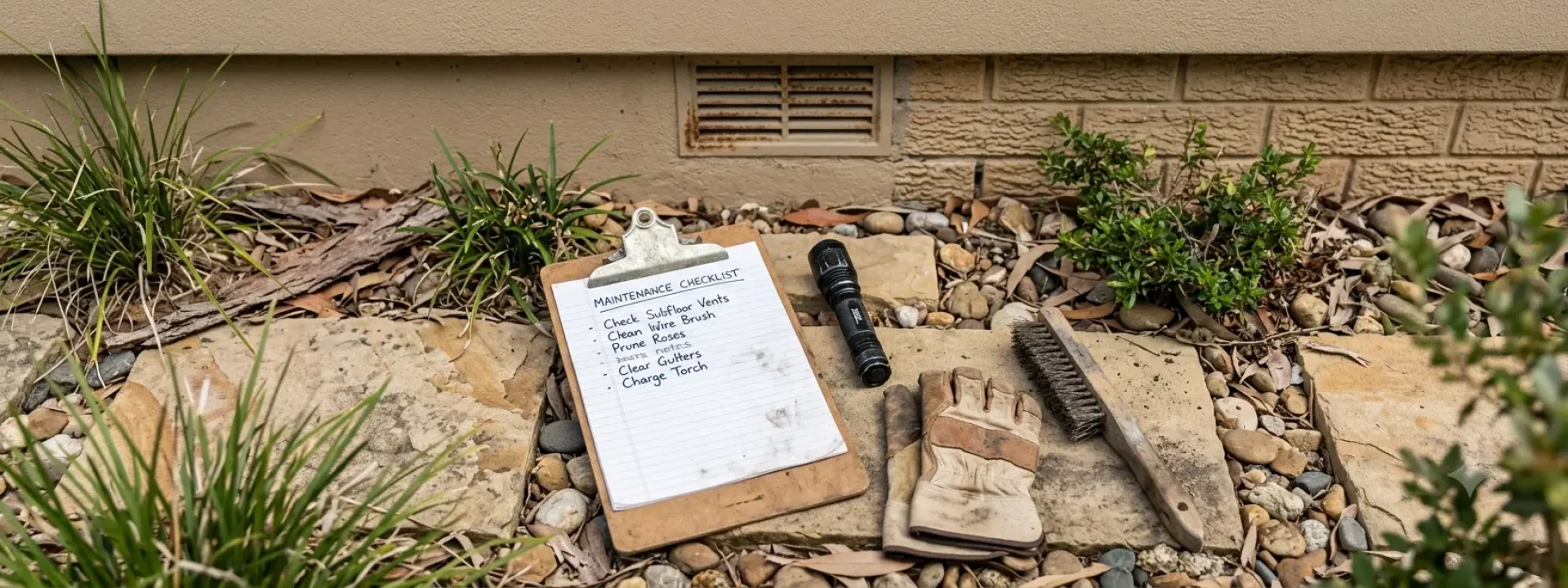
Annual subfloor maintenance Sydney homeowners schedule at a consistent point each year is one of the simplest habits for avoiding the kind of gradually developing problems that turn a minor fix into a significant repair. Annual subfloor maintenance Sydney properties benefit from doesn’t need to be complicated – a consistent checklist covering vents, drainage, mechanical system servicing, and a review of any outstanding issues catches most developing problems well before they become serious. This guide sets out a practical annual subfloor maintenance Sydney homeowners can work through each year, drawing together the maintenance principles covered across our other guides into a single, structured checklist.
Whether you tie this review to the end of the calendar year, a birthday, or simply a fixed date that’s easy to remember, the value comes from consistency – a check that happens reliably every year, rather than only when a problem has already become noticeable.
Why an Annual Review Matters
Subfloor conditions change gradually, which is exactly why an annual check is valuable – problems that develop slowly are easy to miss day to day but become obvious when compared against a full year’s worth of change. An annual subfloor maintenance Sydney routine is one of the lowest-cost, highest-value habits a homeowner can build into their broader property upkeep, precisely because it catches issues while they’re still cheap and simple to fix.
Catching Gradual Changes Before They Compound
A vent slowly being obscured by garden growth, a fan bearing gradually wearing down, or subfloor humidity creeping upward over months are all the kind of slow changes that an annual subfloor maintenance Sydney review is specifically designed to catch, compared with only noticing a problem once it’s produced an obvious symptom like a musty smell or visible mould.
Aligning With Sydney’s Seasonal Cycle
Because Sydney’s rainfall and humidity patterns follow a seasonal cycle, timing an annual review to occur after the wetter months and before the drier ones gives the clearest picture of how a subfloor performed under its most demanding conditions of the year, informing whether any adjustments are needed before the cycle repeats.
Annual Maintenance for Rental Properties
Landlords have a few additional considerations worth folding into an annual subfloor maintenance Sydney routine.
Coordinating Access With Tenants
Scheduling an annual check requires reasonable notice to tenants under standard NSW residential tenancy requirements, and coordinating timing that minimises disruption – particularly for any garden or yard access needed to check external vents and drainage – helps the review happen smoothly each year rather than being repeatedly postponed.
Documenting Findings for Property Records
Keeping a consistent annual record across a rental property’s ownership – even where different property managers or tenants are involved over time – gives a landlord a clear, continuous maintenance history that’s useful both for demonstrating due diligence and for catching gradual changes that a series of different, disconnected observers might otherwise miss.
Responding to Tenant-Reported Issues Between Reviews
An annual review is a useful anchor point, but it shouldn’t be the only time subfloor issues are considered. Tenant reports of musty smells, visible dampness, or other concerns raised between scheduled annual reviews should still be investigated promptly rather than deferred to the next yearly check.
Annual Checks for Multi-Storey and Split-Level Homes
As discussed in our guide to multi-storey home ventilation, larger and more complex properties benefit from a slightly more thorough annual review.
Checking Each Subfloor Zone Separately
For split-level homes with multiple distinct subfloor zones, an annual subfloor maintenance Sydney check should cover each zone individually rather than assuming a single check of one accessible area represents the condition of the whole property, since different zones can develop different issues at different rates.
Reviewing Plumbing Penetration Points
Given the additional plumbing penetrations common in multi-storey homes, an annual check is a good opportunity to visually confirm these penetration points remain properly sealed, since a slow, minor leak at one of these points can otherwise go unnoticed for a considerable time.
Keeping Year-Over-Year Records
The real long-term value of an annual review comes from being able to compare conditions across multiple years, not just assessing a single point in time.
Tracking Humidity Readings Over Time
Keeping a simple year-over-year log of subfloor humidity readings, taken at a consistent time of year, builds a genuinely useful trend picture that a single annual snapshot alone can’t provide, making it much easier to spot a gradual decline in performance or a genuine improvement following an upgrade.
Comparing Photos Across Years
Taking photographs of the same vents, subfloor areas, and any previously noted trouble spots each year, following the documentation approach covered in our guide to documenting moisture damage, creates a visual record that makes subtle changes – a vent gradually corroding, a garden bed slowly encroaching – much easier to notice than relying on memory alone.
Building a Property Maintenance File
Combining humidity logs, photographs, warranty documents, and inspection reports into a single, organised property maintenance file – whether physical or digital – means this information is genuinely useful when needed, rather than scattered across years of emails, invoices, and phone photos with no clear organisation. This kind of organised record is exactly what turns a series of individual annual subfloor maintenance Sydney checks into a genuinely useful long-term picture of a property’s condition.
The Vent and Airflow Check
The most fundamental part of any annual subfloor maintenance Sydney routine is confirming that existing vents are still doing the job they were installed to do.
Clearing Vegetation and Garden Growth
Garden beds, mulch, and general plant growth can gradually encroach on external vents over the course of a year, particularly during Sydney’s warmer growing months. Clearing this growth back from all vents restores the airflow path that may have been gradually reduced without anyone noticing.
Checking for Physical Damage or Blockage
A visual check of each vent for cracks, corrosion, loose fittings, or accumulated debris – leaves, insect nests, or general dirt build-up – identifies straightforward maintenance issues that are simple to fix once noticed but can meaningfully reduce airflow if left unaddressed.
Confirming Internal Airflow Paths Remain Clear
Where subfloor access allows, checking that internal airflow paths between vents remain unobstructed by stored items, accumulated debris, or new landscaping changes made during the year – discussed in more detail in our guide to subfloor air circulation science – is worth including as part of the same check, since obstruction here can undermine even well-maintained external vents.
Drainage and Ground-Level Review
Because water reaching the subfloor in the first place is usually the biggest factor in subfloor moisture, an annual drainage check is a natural companion to the vent check.
Gutters and Downpipes
Clearing gutters and confirming downpipes remain unblocked and discharge well away from the foundation is a straightforward task worth including in every annual subfloor maintenance Sydney routine, particularly given the documented trend toward more intense short-duration rainfall discussed in our guide to climate change and subfloor moisture in Sydney.
Ground Grading and Drainage Paths
Checking that ground level still slopes away from the foundation – since garden work, new paving, or general ground settlement over a year can gradually change this – and that any surface drains remain clear of debris, catches drainage issues before they translate into subfloor moisture problems.
Reviewing Any Interim Measures Still in Place
For homeowners who previously implemented budget-friendly interim measures while planning a professional system, an annual review is a natural point to reassess whether those measures are still adequate or whether it’s time to move ahead with the professional installation originally planned.
Mechanical System Servicing
For properties with a mechanical ventilation system, an annual service is a standard part of keeping the system performing as designed.
Cleaning Fan Blades and Housings
Debris accumulation on fan blades can gradually cause imbalance and the kind of noise issues discussed in our guide to subfloor ventilation noise. An annual clean, as part of broader servicing, prevents this gradual wear from developing into a more noticeable problem.
Checking Sensor Calibration
For systems with humidity-responsive controls, confirming that sensors are still providing accurate readings – rather than having drifted out of calibration over the course of a year – ensures the system continues responding appropriately to actual subfloor conditions rather than inaccurate data.
Reviewing Fan Performance Against Baseline Readings
Comparing current fan performance and subfloor humidity readings against the baseline established when the subfloor ventilation system was first installed, as discussed in our installation guide, helps identify gradual performance decline that might not be obvious from a single point-in-time check alone.
Termite Inspection Timing
Annual subfloor maintenance Sydney routines should align with, rather than replace, the separate professional termite inspection schedule covered in our guide to the connection between ventilation and termite prevention.
Confirming Your Inspection Is Current
AS 3660.2 recommends termite inspections at least every 12 months, so an annual maintenance review is a natural prompt to confirm whether your most recent professional inspection is still within this window, and to book the next one if it’s due.
Noting Any Changes Worth Mentioning to Your Inspector
Any changes noticed during your own annual check – new garden growth near the foundation, a vent that needed clearing, or a section of subfloor that seemed more humid than usual – are worth specifically mentioning to your termite inspector, since this context can help them focus their assessment on areas of genuine change rather than relying solely on their own visual survey. Where those changes look more like a capillary rising damp pattern than general humidity, it’s worth raising that distinction too, since it points toward a different specialist follow-up than a termite-focused inspection alone would address.
Reviewing Outstanding Issues and Documentation
An annual review is also a sensible point to take stock of anything flagged previously but not yet fully resolved.
Checking the Status of Any Previously Identified Issues
Where a previous inspection or assessment flagged a developing issue – early-stage mould, a section of undersized ventilation, or a moisture pattern suggestive of rising damp – the annual review is a good time to confirm whether that issue has been addressed, has worsened, or still needs attention. Unresolved mould found during this check should be addressed with professional mould solutions rather than left for another year, and any capillary moisture pattern consistent with rising damp should prompt a dedicated rising damp treatment assessment rather than being treated as a ventilation-only concern. This is one of the most valuable parts of an annual subfloor maintenance Sydney routine, since it stops a known, flagged issue from quietly persisting simply because it wasn’t revisited.
Organising Documentation From the Past Year
Gathering together any invoices, warranty documents, inspection reports, and photographs from work carried out during the year – following the documentation practices covered in our guide to documenting moisture damage – keeps a property’s maintenance history organised and ready to reference, whether for a future warranty claim, an insurance matter, or eventually selling the property.
Reviewing Warranty Status
Checking whether any product or workmanship warranties, as discussed in our guide to subfloor ventilation warranties, remain current, and noting when they’re due to expire, helps homeowners plan ahead for any servicing or replacement decisions before coverage lapses.
Planning for the Year Ahead
Beyond checking on the current state of things, an annual review is a natural point to plan any upgrades or changes for the coming year.
Budgeting for Any Identified Upgrades
Where the annual check identifies a genuine gap – inadequate capacity for the property’s actual moisture load, an ageing mechanical system approaching the end of its serviceable life, or a heritage property needing a properly approved ventilation upgrade – using the annual review as a prompt to budget and schedule this work, rather than letting it drift indefinitely, keeps a property in front of problems rather than reacting to them once they’ve become serious.
Considering Technology Upgrades
For homeowners with an older system, the annual review is also a reasonable point to consider whether newer ventilation systems technology – discussed in our guide to the future of subfloor ventilation – might be worth incorporating, whether that’s retrofitting smart humidity sensors to an existing system or planning a fuller upgrade.
Setting a Reminder for Next Year
Because the value of an annual subfloor maintenance Sydney routine comes from consistency, setting a calendar reminder for the same time next year – rather than relying on remembering to do it again – is a simple but genuinely effective way to maintain the habit over the long term.
A Simple Annual Checklist Summary
Bringing the above together, a practical annual subfloor maintenance Sydney checklist covers: clearing vegetation and debris from all vents; checking vents for physical damage; confirming internal airflow paths remain clear; clearing gutters and downpipes; checking ground grading near the foundation; servicing any mechanical fan system, including cleaning and sensor calibration; confirming your termite inspection is current under AS 3660.2; reviewing the status of any previously identified issues; organising the year’s documentation and warranty records; and budgeting for any upgrades identified during the review.
When an Annual Check Points to Something Bigger
Occasionally, an annual subfloor maintenance Sydney review turns up something beyond routine upkeep – a pattern of worsening humidity despite consistent maintenance, a fan that’s needed repeated repairs, or ground conditions that seem to be shifting year over year. When this happens, it’s worth treating the annual check as the trigger for a proper reassessment rather than simply repeating the same maintenance tasks and hoping the underlying trend reverses on its own.
Recognising When Maintenance Isn’t Enough
If two or three consecutive annual reviews show the same problem recurring despite proper maintenance in between, that’s a reasonably strong signal that the issue isn’t a maintenance gap but an underlying design or capacity problem – undersized ventilation systems, an unaddressed drainage issue, or a moisture source like rising damp that annual vent-clearing and gutter-cleaning was never going to resolve on its own.
Using Annual Data to Support a Professional Assessment
Bringing several years of humidity readings, photographs, and maintenance records to a professional subfloor ventilation assessment gives a specialist considerably more to work with than a single current snapshot, often making their diagnosis faster and more accurate than starting from scratch.
Suburb-Specific Timing Considerations
While the checklist itself applies broadly across Sydney, timing and emphasis can shift slightly depending on location.
Reactive Clay Suburbs
For properties across Parramatta, Liverpool, Penrith, and the broader Cumberland Plain, discussed in our guide to Sydney’s soil and moisture science, an annual review is particularly worth timing after the wetter months, when the shrink-swell cycle typical of reactive clay sites has had its most significant recent impact on subfloor conditions.
Coastal and Low-Lying Suburbs
For properties near Botany, the Cooks River, or other low-lying, high-water-table locations, an annual review might reasonably include a check on whether groundwater-related humidity patterns have changed noticeably compared with previous years, given the longer-term groundwater trends discussed in our climate change guide.
Heritage and Older Suburbs
For heritage-listed properties across Balmain, Leichhardt, Paddington, and similar suburbs, an annual review is a sensible time to confirm that original or heritage-matched vents, discussed in our heritage ventilation guide, remain in good condition and haven’t been inadvertently obscured by any landscaping or maintenance work carried out during the year.
Purposeful Information
Q: How long does an annual subfloor maintenance check typically take?
A: For a straightforward property with good access, a thorough DIY check of vents, drainage, and general conditions can typically be done in an hour or two. Professional servicing of a mechanical system adds additional time depending on system complexity.
Q: Can I do this maintenance check myself, or do I need a professional?
A: Many parts of the checklist – clearing vents, checking gutters, general visual inspection – are reasonable for a homeowner to do themselves. Mechanical system servicing, sensor calibration, and any suspected moisture or termite issues are better handled by the relevant professional.
Q: What’s the best time of year to do this in Sydney?
A: Timing it after Sydney’s wetter months and before the drier season gives the clearest picture of how the subfloor performed under its most demanding recent conditions, though any consistent annual date is better than no routine at all.
Q: Does an annual maintenance check replace my professional termite inspection?
A: No. They’re complementary. Your own annual check can prompt you to confirm your professional termite inspection is current under AS 3660.2, but it doesn’t substitute for that dedicated, licensed assessment.
Q: What should I do if my annual check finds a new problem?
A: Document what you’ve found – photos and notes on location and extent – and arrange the appropriate professional assessment based on what you’ve observed, whether that’s a ventilation specialist, a rising damp specialist, or a pest inspector.
This guide provides a general annual maintenance checklist for subfloor ventilation and is intended for educational purposes. It doesn’t replace a professional assessment where a specific issue is identified. For a thorough property-specific review, consult a qualified subfloor ventilation specialist.